



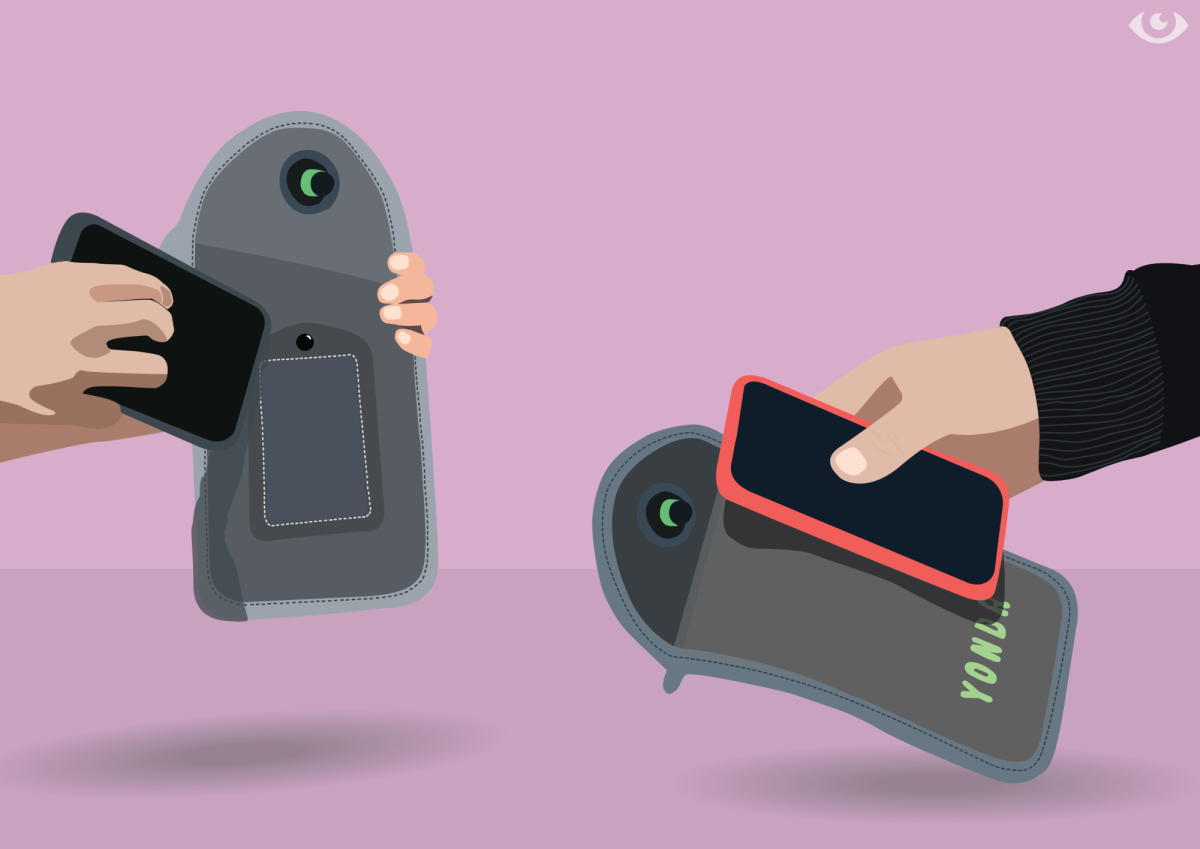
On May 13, 2025, Jefferson County Public Schools (JCPS) voted to ban telecommunication devices during the school day. The district enacted the ban following a state law that banned the usage of cell phones during school hours. Kentucky was the 15th state to decide to completely ban phones in schools.
Manual’s policy for telecommunication states that all phones should be powered off and kept away during school hours, from 7:30-2:10. All JCPS schools have similar rules, including that devices should be out of sight, even during lunches and passing periods. However, there have been varying opinions and controversies regarding whether students should be able to have their devices back out or if the ban ultimately helps learning environments.
Manual RedEye conducted a poll of Manual students and found that 83.3% of students don’t think the phone ban was necessary at Manual. The poll also found that only 23.4% of students believe the phone ban has had a positive impact on their academics.
Kensley Cormney (10, HSU) thinks that the ban may have improved students’ focus, but she views it as a mostly negative policy, especially when it comes to communication.
“It can limit communication with parents. I know I talk to my mom a lot, so talking to her, it’s limited a lot when I actually need to talk to her about stuff, and it can definitely do that to other students as well,” Cormney said.
She said that the ban has made it more difficult for her to complete projects and other assignments, especially because she is no longer able to communicate with her peers during the day. It has also made it harder for her to get schoolwork done, because her cellphone made small tasks more convenient.
“It was way easier last year, like just to whip out my phone, like maybe as a calculator … or when I needed to look up something really quickly,” Cormney said.
According to a study conducted by Seattle Children’s Research Institute, the average adolescent spent 1.5 hours on their phone during school, accounting for 27% of their daily phone use.
Norton Healthcare Clinical Child and Adolescent Psychologist Katy Hopkins noted that when students can’t be around their peers, cellphones can be a helpful alternative to still be able to socialize. Be that as it may, interacting this way causes teens to miss out on nonverbal cues that are beneficial to social skills development.
“Being an adult requires that we interact with people, maintain relationships, both close and professional, and even acquaintance relationships in ways that allows us not only to get our needs met, but also to get the social support that’s really crucial to our well-being,” Hopkins said. “And so if we miss out on practicing those routinely, those in real life relationships, it really inhibits our ability to have those skills.”
While the phone ban may help students develop social skills, there are consequences to it. During the first week of school, Hopkins had multiple teenagers schedule crisis appointments with her due to experiencing withdrawal symptoms. Though it may not seem as obvious an addiction as being addicted to drugs or alcohol, phone usage can activate the same addictive behavior in the brain as those substances.
“If you’re addicted to your cell phone or to a screen, you will need more and more of it to kind of feel satiated, but it’s never enough. And you continue to use it despite clear evidence that it is causing a lot of problems in your life,” Hopkins said.
Hopkins noted that phone bans aren’t necessarily effective at reducing overall screen time. This can be seen in RedEye’s poll data, which found that only 63.9% of students spend zero hours on their phone during the school day, even with the phone ban in place. There is also an increase of screen time at home, as 64.4% reported spending more time on their phones after school compared to last year.
Thomas Galla (12, MST) sees the phone ban as both positive and negative.
“I think teachers are being less distracted by students being idiots and being on their phones in the middle of class are not supposed to, but I do think it makes some online style teaching harder for accessibility,” Galla said.
He added that his screen time hasn’t changed. It has simply switched devices. Galla said that he now spends more time on his chromebook as a result of the ban. He also does not think that the phone ban has contributed positively to student interactions. Galla believes that it has actually limited communication, particularly between students in other classes.
However, other students have had different experiences. Beau Allen (12, YPAS) says that the phone ban does not really impact his screen time outside of school. Instead of the phone ban, he thinks that there are other options.
“I think that there are better alternatives than locking up phones for an entire school day. Instead, we could be doing something that promotes healthy study time and phone breaks,” Allen said.
While a 2025 Common Sense Media report found that nearly 25% of children under 8 years old have a cell phone, Bloom Elementary School Principal Jack Jacobs hasn’t noticed a significant impact on his school. Before the phone ban, teachers would tell students to put their phones away in their backpack. Students were allowed to keep them near them in case of an emergency, so they could contact their parents. However, he believes the policy was necessary in order to have uniform guidelines across schools related to cellphone usage.
Though he believes the policy was necessary, Jacobs also recognizes that different families have different needs related to cellphones and what is best for their child.
“We want families to make the decision, because there are families that the kids need phones. And there are families that don’t want their kids to have a phone. And so, that’s not my job to make that rule,” Jacobs said.
When it comes to socializing, Jacobs hasn’t noticed a significant difference in his students from before the ban, since elementary schoolers were less likely to rely on phones for socialization anyway. This is a sentiment that Hopkins also noted.
“Even before the cell phone ban, if you went and you visited elementary school playgrounds, you would still see children running around, having fun, playing with each other, going on the swings and the slides and all of those things, even if they had access to a cell phone,” Hopkins said. “But if you visited middle and high schools during lunch or during free periods, it would not be unusual to see individual students sitting by themselves looking at their phones.”
The only social consequence Jacobs is concerned about is older elementary students feeling left out for not having a cellphone if their peers do. To find strategies to help their children succeed, Jacobs recommends that parents research programs based on their kids’ needs and know the guidelines for each app their child uses.
At the middle school level, the phone ban has had impacts on socialization.
“We do see more conversations at lunch instead of students looking at just a screen,” said Noe Middle School Sixth Grade Assistant Principal Michael Wade.
Wade does mention that this may be due to previous plans for phones within the building. He described how Noe Middle had already had a relatively strict policy on phones. The students weren’t allowed to be on their phones a majority of the time before the state policy had been put into place, so Wade claimed that their previous regulations had helped ease students into the ban.
Ryan Blackwell, Manual’s school safety administrator, agrees that the phone ban has led to increased positive social interactions.
“Kids in class are more engaged in talking because it used to be the teacher got to dictate if the phone could be in their classroom or not,” Blackwell said.
He also thinks that the phone ban has helped limit conflicts between students, because the phone can no longer serve as a medium for negative exchange.
“When I was at a different school, a lot of the times cell phones would kind of be what started altercations and such. So they were able to get a group around or have a crowd,” Blackwell said.
He has seen positive influence from the phone ban even during passing periods and lunch. In Manual’s courtyard, there is a four square court that students are able to use during the lunches.
“I’ve never seen so many kids wanting to play four square because they don’t have their phone. So we’ll have a line of 30 kids. Like we almost need two or three courts out there because kids are wanting to do something else, but not be on their computer,” Blackwell said.
As JCPS continues to enforce its phone ban, questions remain about how increased digital communication affects teenagers’ and children’s mental health and development. Research consistently shows that higher screen time and frequent smartphone use are linked to negative outcomes in growth, including increased rates of anxiety, depression and sleep disruption.
Studies reviewed by the American Academy of Pediatrics found that early and excessive smartphone use is associated with depressive symptoms, insufficient sleep and even physical health concerns, such as obesity.
For families who struggle with their child’s phone usage, Hopkins recommends protecting sleep first by turning off all screens an hour before bed, as well as setting guidelines as a family regarding screen usage in other settings, such as at the dinner table. Though it may be difficult, it’s also important for parents to model the behavior they want their children to follow when it comes to screentime. Otherwise, their children may begin to resent the rule or feel that they don’t have to follow it.
“Teenagers are pros at noticing when their parents are being hypocrites or when their teachers are being hypocrites. And they’ll tell us, usually. Or if they don’t tell us, it’s definitely impacting their view of us,” Hopkins said.
As JCPS evaluates the effectiveness of its policy, these studies highlight the broader conversation surrounding technology use in school not just about distraction, but about long-term mental health and developmental outcomes for students.
At the state level, Kentucky lawmakers have taken action in recent legislative sessions aimed at regulating students’ phone use in schools. In 2025, the Kentucky legislature passed a law which directly influenced JCPS’ decision to enact its district wide ban. Similar bills have been proposed in prior years, seeking to standardize phone policies across public schools to address concerns about student focus, classroom disruption and well-being.
Some Kentucky schools are already using Yondr pouches, lockable fabric cases that students secure their phones in for the school day, to comply with the law while allowing students to keep their devices with them. These legislative efforts reflect a growing trend among states to limit in-school phone access, citing both academic research and feedback from educators and parents as justification for statewide standards.


