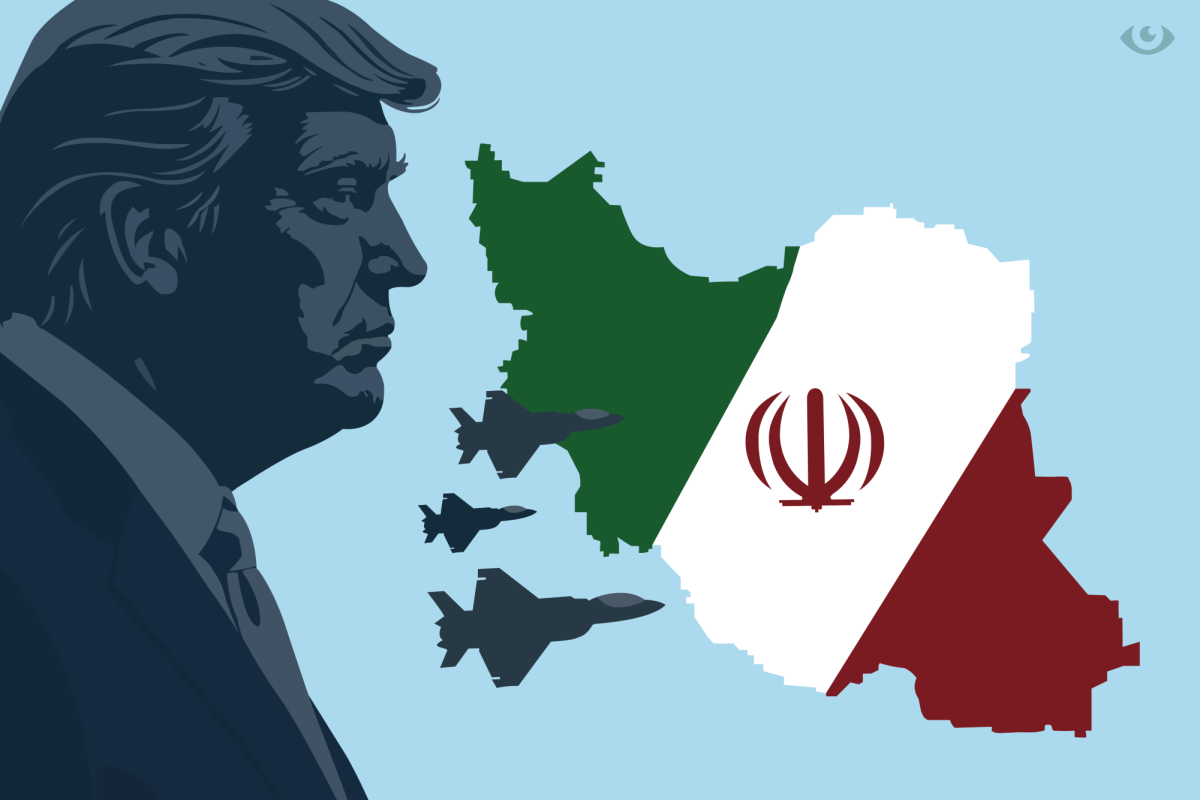
Tensions between the United States and Iran have existed for decades, from the 1979 Iranian Revolution to the disputes over nuclear development and economic sanctions. The tension has since escalated.
On Feb. 22, President Donald Trump authorized U.S. airstrikes against Iran. The airstrikes were aimed at Iranian sites connected to Iran’s expanding nuclear program after U.S. intelligence officials warned that Tehran was increasing nuclear activities. Administration officials in the U.S. described the strikes as a “preventative measure” that was intended to weaken Iran’s capacity and deter future nuclear development.
One student, who wished to remain anonymous, said the nuclear justification is often presented without full context.
“It is often presented as something sudden,” they said. “When in reality it comes from a long history of involvement in the region that people need to understand to see the full picture.”
Days later, on Feb. 28, the U.S. and Israel launched a major coordinated offensive against Iran in what military officials described as “one of the most critical attacks in decades.” Explosions were reported in Tehran and other cities as missiles and airstrikes began targeting military installations, missile facilities, air defense systems and command centers across the country.
In the hours following the strikes, Israeli media outlets began claiming that Iran’s Supreme Leader, Ayatollah Ali Khamenei, had been killed, and American networks soon followed with the same claim. For most of the day, however, there was no official confirmation from Tehran on his death. The lack of an immediate statement from Iranian News led to speculation and uncertainty.
Later that afternoon Iranian news outlets confirmed the death of Khamenei. Khamenei was not only Iran’s political leader but also its highest religious authority, with relations back to the Prophets.
Since 1989, Khamenei has held ultimate power over the military, judiciary and major state decisions. As a senior Shia cleric, it was his job to shape Iran’s domestic policies and its stance on the West. His political and religious position in Iran made him one of the most influential figures in the Middle East for more than three decades.
Because of Khamenei’s influence, his death immediately shifted the focus from military targets to a broader political message behind the airstrikes. U.S. officials defended the operation as a necessary action to dismantle Iran’s military leadership and prevent further escalation. Trump claimed the attack was an opportunity to “liberate Iran,” urging citizens to “take back your government.” He warned Iranian officials that if Iran retailed, the United States would respond with force “like never before.”
Many American citizens have since felt uncertain about the direction of the conflict. In the days following the strikes, social media platforms were filled with posts questioning the strategy and long-term goals of the operation.
“From an outside perspective, Trump’s approach to Iran so far seemed full of holes,” a Louisville resident who prefers to go by Whitney Ngyuen said. “The current attacks don’t seem to have a clear, organized end goal.”
Within hours, Iran responded by launching missiles and drones toward Israeli cities and U.S. military bases across the Persian Gulf. One Iranian drone struck near the U.S. Navy’s Fifth Fleet base in Bahrain, causing a major fire, injuring four people and killing three American soldiers. Since then, airspace across parts of the Middle East has been temporarily disrupted as countries assess the security risks and prepare for further retaliation.
Satellite images released in the days that followed showed visible damage at Iranian naval facilities, missile storage sites and radar systems. Iranian officials have also confirmed an airstrike on an all-girls school in Minab, killing around 150 students. Images from the scene have widely circulated, raising international concern about the humanitarian impact of the escaping conflict between the U.S., Iran and Israel.
“I feel like it’s just an invasion of countries that are just fine on their own,” Eusir Alsaedy, (11, MST), said. “Trump could intervene in other ways by making peace deals instead of just bombing innocent families.”
“What worries me the most is that innocent people would suffer the most,” the anonymous student said. “These decisions are not just political strategies, They permanently change families and entire communities.”
The airstrikes on Iran have since sparked a political debate within the U.S. Several lawmakers have called for a War Powers vote, arguing that Congress is required to authorize sustained military involvement. Protesters gathered outside of the White House and demonstrators urged leaders to prioritize diplomacy instead of expanding military action.
“You cannot build real diplomacy while threatening force at the same time,” the anonymous student said. “It creates fear and distrust instead of cooperation”
With Khamenei’s death confirmed, Iran has begun selecting a new supreme leader. An interim leadership council is overseeing state affairs while the Assembly of Experts prepares to choose a successor.
“It’s difficult for me to be confident in a war without clear motives,” Nguyen said. “These decisions will shape the world younger generations are inheriting.”
With no formal agreement of a ceasefire in place, the tensions between the two countries remain high. The long-term political, economic and humanitarian impacts of the strikes are still unfolding, and leaders on both sides haven’t ruled out additional responses.