With voting age years ahead, only 29% of teenagers interact with news daily. Now that politics are encroaching on everyday aspects such as daily costs, education and civil rights, they’re becoming harder to ignore. For teens, politics influence everyday social interaction at home and at school.
The Kenan Institute for Ethics found that many teens frequently discuss politics with family members, especially around elections or other political events. This often leads to teens aligning themselves with their parents’ political values. At schools, clubs such as Students Demand Action, Young Democrats and Young Republicans, allow students to openly discuss their views on current issues.
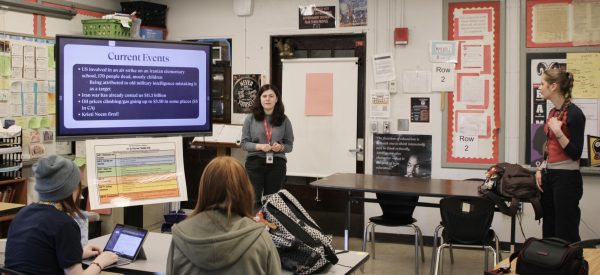
There are also organizations outside of the school building that offer teens the ability to get involved in politics outside of the school building. This includes the Democracy and Culture Foundation, which seeks to give young people experience with deliberative democracy, and the Commonwealth Club, where teens can participate in youth advisory councils and forums.
Now in the digital age, teenagers are already flooded with political content. According to the Pew Research Center, as of 2025, 43% of younger social media users (18–29) access news via TikTok, while 41% find news on YouTube and Facebook and 40% on Instagram.
Regardless of the platform, young people are exposed to news and politics online, whether or not they choose to engage with them. Within Manual, students remain divided on whether or not they are politically active.
In a snapshot poll of 216 students at Manual, 61.6% reported they considered themselves politically involved, with 38.4% reporting they were not. But 93.9% of participants reported they believe that it’s important for teenagers to keep up with current events.
“When we have voters that are going in and growing up to be ignorant, not knowing anything that’s going on and simply voting off of what other people say, it’s not giving people voice and it’s betraying the idea of voting itself,” Kentrai Golston (9, J&C) said.
The way teens consume this information also highly differs. 43.7% of participants in the flash poll reported that social media is their primary source of information while 36.2% reported that they use news outlets. Other responses include parents, friends and Andrew Tate’s podcast.
When social media becomes one’s primary source of news, the risk for misinformation grows. Statista found 29% of people aged 18–29 reported they see false information online daily. This percentage grows with age, increasing by about 26% by the time the user is 45 to 64 years old.
For many teenagers, keeping up with politics is important and something they pride themselves on.
“I think it’s important for everyone to keep up with politics because, as you can see, there’s been major changes to everyone in life, whether you are elderly, middle-aged or you’re a teenager,” Justeena Kemp (10, HSU) said.
Oftentimes, when teenagers feel politics affect them personally, they make more of an effort to keep up with current events.
“A lot of my friends are within the queer community, and when it gets to the point of they’re [lawmakers] talking about reversing the current law on gay marriage, that’s something that poses an issue for the future,” Mox Wilson (11, YPAS) said.
Some feel that politics affects their curriculum. Certain classes are prone to discussing politics, while others say that teachers often insert their personal opinions into class discussions.
“I think that I’m much more open to certain topics in a history class or, for example, I’m taking AP Lang [and] whenever we talk about modern events or how things in the past are tied into things going on today,” Dashel Sutton (11, YPAS) said.
Teenagers who maintain an active political profile also run the risk of outside influence and pressure to believe a certain thing, especially from parents.
“I can’t talk to some of my family in general about politics — and I like to think I’m pretty reasonable and am easy to have a calm conversation with. But certain members of my family, if I argue or have a conversation about politics, they feel as though it’s attacking them,” Joel Huffstickler (11, HSU) said.
In addition, politics for teenagers and adults often end up affecting personal relationships.
“[Politics] hasn’t [impacted my relationships] in a large way, but there are some people who I have tended to like less because of how much they care. Not normally them disliking me, because I don’t care, it’s normally the other way around,” Patrick Galla (10, YPAS) said.
Overall, Manual students believe it’s important to keep up with politics and many choose to do so. As teenagers, students start to feel the effects of politics on their daily life, and in this realization they explore political engagement.