An hour before a kind-looking older woman said that the Hiroshima bomb shook her haven in China from Nazi terror, a screen told me the same thing.
Organizers had set up a room with a couple of TVs, playing a well-produced YouTube video that Jude Kline, and her late family, starred in.
Survivors like her are thinning in numbers. People who had felt like legends in past ceremonies were on a memorial slideshow. Yom HaShoah, the holiday that the Louisville Jewish community commemorates with an event every year, has lost many of the people who made it.
A couple hundred people met at Adath Jeshurun’s auditorium after seeing the rest of the programming. For all the time that the Yom HaShoah ceremony has lost, it has gotten younger. Especially this year. There was a table for things that elementary schoolers had made for it — kind messages, trifolds with historical facts, drawings upon drawings. Three or four 10-seater rows: kids.
“It’s the young people that are going to carry on, make this world a better place. I’m afraid we messed it up pretty good,” Mark Smith, a quick-witted community member, said.
One tradition endured. “Yom HaShoah” means “Day of the Shoah,” or “Day of the Catastrophe,” the former containing the preferred Hebrew word for Nazi Germany’s slaughter of over 10 million people, six million Jews among them. Some researchers have put the number at 11 million, and at Yom HaShoah, organizers lit 11 candles.
Kline and her family lit the first one. The family of a late survivor, Ernie Marx, lit the second. Shoah educators, second-generation survivors, student leaders, organizers — every kind of ally imaginable went up to light one. Students, rotating by school, narrated it all. After every candle, they repeated, “Niz-kor: We will not forget.”
Kline spoke for about half an hour. No Holocaust story starts with the camps, but Kline’s is a rare one that did not feature them until the very end, when the war was over and they scoured a list of survivors for their relatives. They were dead. She was 8 years old. She remembers them around this time every year with ceremonial candles.
Her story until that point had flashed of the brutality. Jewish people couldn’t get surgery, so the Nazis killed her grandpa with a hernia. When they fled to Shanghai, China, like around 20,000 other Jews did, her grandma stayed home.
“She felt certain that the Nazis would not harm an old woman in her 70s,” Kline said. She did not say whether her grandma lived much longer after that idea ruptured.
“Most Jewish people have felt more vulnerable,” David Lipp, the cantor who sang throughout, said to me afterward. Since Hamas attacked Israel on Oct. 7, 2023, and since Israel killed 70,000 Palestinians in the time after that, the world has gotten more hateful. Data abounds. While visiting Montreal, Lipp wore a cap instead of a more obvious kippah to cover his head (a tradition that’s common among Jewish men).
“We chose both to tell a story from the Holocaust, but also to get someone to speak to us from the position of being an ally. Because it’s good to know who your friends are,” Lipp said.
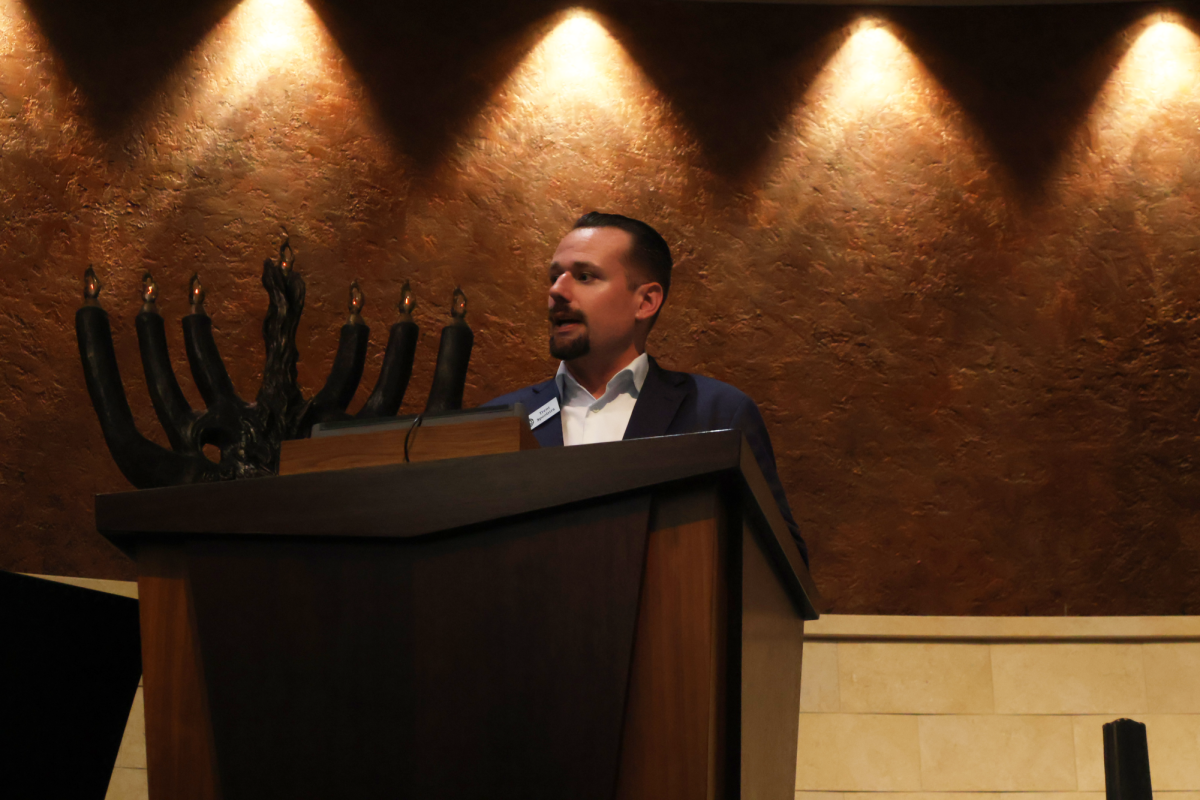
Their friends had plenty to say, themselves. Luis Fuentes, a leader of Cuban Kentuckians, spoke for several minutes.
“Today, as we walk the streets of Louisville, we see Cuban businesses flourishing alongside synagogues. That serves as a beacon of light,” he said. “We are two communities that have enriched the fabric of this commonwealth, two communities who love this land, precisely because we know what it feels like to lose our own.”
Shortly after World War II ended, a Communist coup gave Cuba a dictator and tense relations with the US. There are about 60,000 Cuban-Americans in Louisville.
“We are confronting the reality of what happens when the world remains silent in the face of hatred,” Luis Fuentes said.
A conservative writer close to Vice President JD Vance recently said that around a third of all young Republican staffers in Washington, D.C. are fans of Nick Fuentes, the radical influencer who once said it plainly:“I’m just like Hitler.” Meanwhile, against judges’ orders and constitutional protections, immigration officials send people who fled places like Cuba right back home.
And so we prayed.
Elie Wiesel’s “Night,” a memoir about the Shoah, introduced millions to the Mourner’s Kaddish, a Jewish prayer for the dead. It does not mention death once: “May the great Name of God be exalted and sanctified throughout the world,” the first lines’ translations go. People recited it in every camp. Some said it as they died.
At Yom HaShoah, after every line, we named a Nazi murder site: Auschwitz, Dachau, Warsaw, Bergen Belsen, Ravensbruck, Vilna, Treblinka, Chelmno, Belzek, Buchenwald, Sobibor, Maidanek, Mathausen, Lodz, Babi Yar. The prayer kept going, and we named other sites of savagery: Syria, Burma, Armenia, Bosnia, Rwanda, Darfur.
After that, the cantor sang, and the night ended.
In a speech introducing “Praeludium,” an orchestral piece played by the Floyd Central High School orchestra, Doug Elmore said that its composer, who was killed during the Shoah, wrote in an “E-D-E” motif for the first three letters of his friend’s name. Jakob Edelstein died in Auschwitz.
After the programming, Smith said that the news has made this a very long couple of years. It is easy to imagine a world as cruel as this one. But down the road from butchers were people who snuck their friends into music. And the people with the mic when we said “we will not forget” will live to remember a lot more. Imaginable or not, the world will go on.