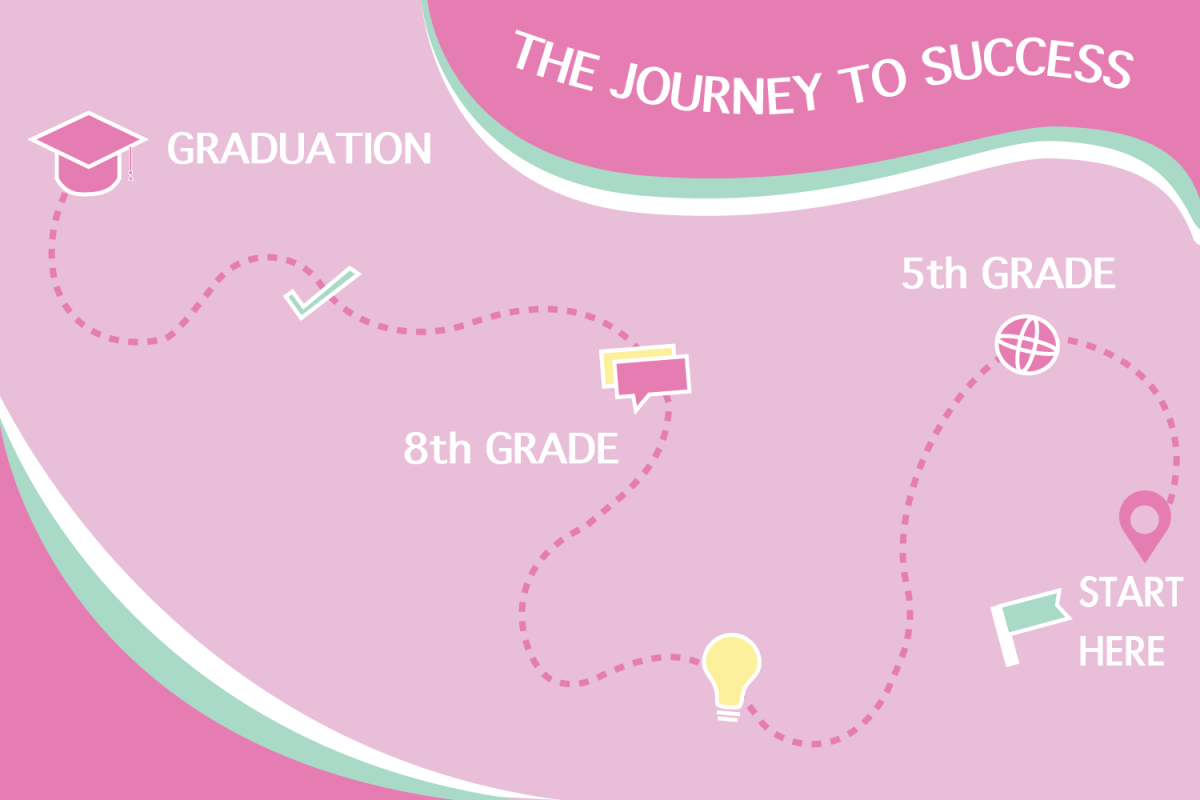
In 2018, former JCPS Superintendent Marty Pollio implemented the Backpack of Success Skills, which was restructured in 2024 to the Journey to Success (JTS). The program was designed to facilitate student-led learning, empower students and help them showcase their growth.
The JTS emphasizes the five success skills: Prepared & Resilient Learner, Productive Collaborator, Emerging Innovator, Effective Communicator and Globally & Culturally Competent Citizen. The JTS program aims to promote these skills through four steps. Students develop their skills, collect “artifacts” that showcase those skills, demonstrate their learning through a yearly mini-defense and finally transition to middle school, high school or graduation after defending their backpack in fifth, eighth and twelfth grades.
The JTS was implemented as a part of the Local Laboratories of Learning (L3) initiative. The L3 initiative is a collaborative project among 18 Kentucky school districts that aims to create meaningful assessment systems. The initiative is meant to emphasize empathy, co-creation, reciprocity and inclusion. However, JCPS is the only district that does The JTS to fulfill the defense of learning and technology graduation requirements.
“Journey to Success is about students being able to articulate their journey as a learner,” said De’nay Speaks, the Executive Administrator for JCPS Academics.
Reflection is an important aspect of the JTS and Speaks believes that the JTS offers opportunities for students to see themselves grow in ways that tests cannot.
“It really is also to try to help teachers and educators understand how we can make education more relevant for students so that it’s not just about assignments, it’s more so about what they are actually learning and how they will apply it in the real world,” Speaks said.
Although the JTS does not need abundant resources and funding, the program requires a lot of effort from administrators, especially Omar Rodriguez-Camacho. Rodriguez is the Academic Instructional Coach (AIC) at Manual and organizes the JTS presentations for seniors to ensure that every student completes it.
English teachers at Manual previously bore the workload of the JTS. Since becoming AIC at Manual, Rodriguez has ensured that the work is evenly distributed among the faculty.
“They have worked really hard to try to take as much of the work off of teachers’ plates as possible,” Daniel Zakem (English) said.
At Manual, the JTS has become something that teachers can look forward to instead of being a source of stress.
“I always really enjoy them [presentations], mostly because I don’t have to do a whole lot anymore. We get a little bit of training, and then we watch and score, and then report those scores, and that’s it,” Zakem said.
At Manual, JTS is organized so that different classes correspond to different skills. Emerging Innovator aligns with science, Effective Communicator with English, Globally & Culturally Competent Citizen with social studies and Prepared & Resilient learner with math. Teachers are reminded to create projects that align with the success skills.
Despite its intentions, the reception of the program is mixed, with students and teachers questioning how effective it is.
“We’ve heard some teachers say that it’s kind of a waste of time, but then others who praise it. It’s give and take,” Rodriguez said.
Georgia Heustis (9, VA) completed her presentation last year at Noe Middle School and sees herself putting off preparation for her senior defense until the time comes.
“There’s nothing special about it. It was just something I got done … I think it was somehow beneficial. But I didn’t really learn much from it,” Heustis said.
Eva Rasigade (12, YPAS) enjoyed reflecting on her experiences from high school when she completed her JTS presentation.
“I think it was a great way to show myself as a student to the faculty. It was a fun experience, and it was really quick and easy … But it shouldn’t necessarily be a requirement,” Rasigad said.
The organization of the JTS varies by school, which may make it more effective at some schools than others. Manual aims to evenly distribute the work among faculty, which is not the case district-wide.
Alexa Millan Uribe, a senior at Wagner High School, feels as though the work of the JTS is not evenly distributed among teachers.
“I do feel like it mostly falls under English teachers. Their class was the only in-school time we had to work on it, and teachers had to push back other plans to make room for it,” Millan Uribe said.
Ultimately, the experience of the JTS changes by school, and each student has a different experience.
“I don’t feel like the backpack defense benefits me, and it feels like a waste of time. It feels like something else I have to rush through,” Millan Uribe said.
Though the program focuses on promoting growth and helping students reflect on their accomplishments throughout their time in school, its efficacy depends on implementation. JCPS does not have a standardized method of implementing the JTS, so its results vary.
“Until we can get the implementation to improve, I’m not sure that we will be able to see tangibly how it has affected most students,” Speaks said.