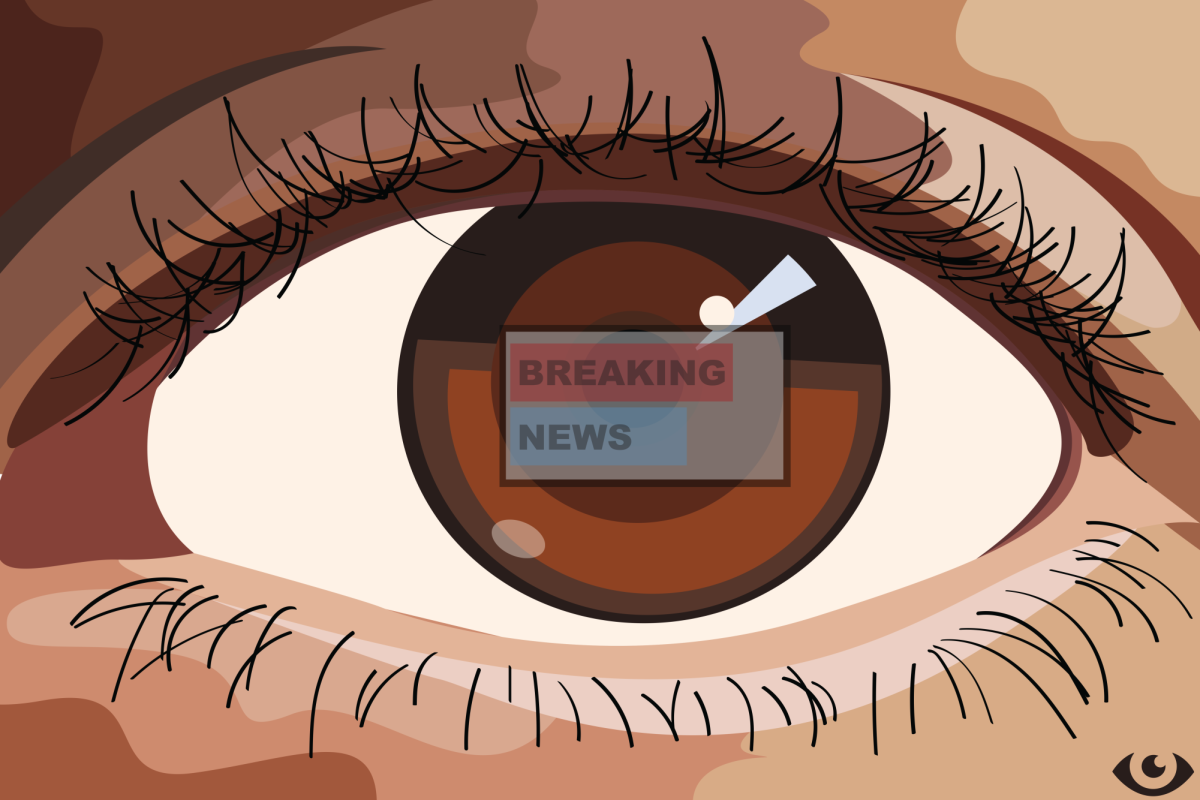
Being informed is often seen as a sign of awareness, responsibility and engagement. Many students and people in general are encouraged to keep up with current events, understand global conflicts and stay aware of issues that can affect their future. However, in today’s media environment, news is easily able to spread through online websites and through social media. Slowly, the line between being informed and being emotionally overworked has become increasingly blurred.
Much of the modern news landscape is defined by an overwhelming amount of information. News platforms like The New York Times, National Public Radio (NPR) and the British Broadcasting Corporation (BBC) provide constant updates, while social media algorithms push out personalized content directly to users. This has led to news no longer being something people actively seek out, but something people are surrounded by.
“It is an absolute difference,” Robin Krause (History) said. “If you go back far enough, there were lots of communities who got their news … from traveling monks and missionaries and maybe a letter may or may not get received over the course of the months.”
This unlimited accessibility to news, however, comes with its limitations. More information doesn’t necessarily mean better understanding. Instead the sheer volume of content can make it harder to distinguish between what is credible reporting and what is misinformation.
“We have actually seen the news market be saturated with low-quality media, low-quality stories, low-quality reporting and low-quality ethics,” Krause said.
For many students, this constant exposure can quickly become overwhelming. Mohammed Mohadin (10, J&C) frequently follows global conflicts, especially in Palestine. For him, these large amounts of negative news take an emotional toll.
“You’re watching all this stuff that is out of your reach, and you feel like you can’t do anything about it,” Mohadin said.
This sense of helplessness is not uncommon. The repeated exposure to distressing news can increase anxiety and feelings of loss. For many people who are constantly checking the news and faced with one disappointment after the other, staying informed can begin to feel less like awareness and more like a cycle of emotional exhaustion.
Still, even with the constant disappointment of news headlines, avoiding the news isn’t the solution. While stepping away from the news may be necessary for one’s mental health at times, complete disengagement creates an uninformed society, something both Krause and Mohadin agree on.
“I don’t think that disengagement is the optimal strategy,” Krause said.
“I’d say not knowing enough is worse,” Mohadin said.
Instead of complete disengagement, the issue is how people engage with information that they find online. Social media has changed not only how quickly news spreads, but how it is consumed. Many people are now able to receive news updates in short clips or headlines, many of which are broadcasted on multiple social media platforms.
The unlimited access to news online can create a false sense of understanding, where people feel informed from only reading the headlines of a story or watching ten seconds of a two-minute clip. Instead of gaining understanding, many are left with an incomplete or misled impression of complex issues, which can confuse them and, over time, make staying informed feel more overwhelming than empowering.
“It is entirely possible to have too much,” Krause said. “You just have to make a choice about how much you consume.”
As access to news continues to expand, the question is not whether it is possible to be too informed, but whether or not people are able to handle the information they receive. In a world where news is accessible everywhere, the challenge is learning how to properly interpret it and knowing when to step away when necessary. Being informed as a society remains essential, but without knowing how to balance the information, it can become overwhelming.