


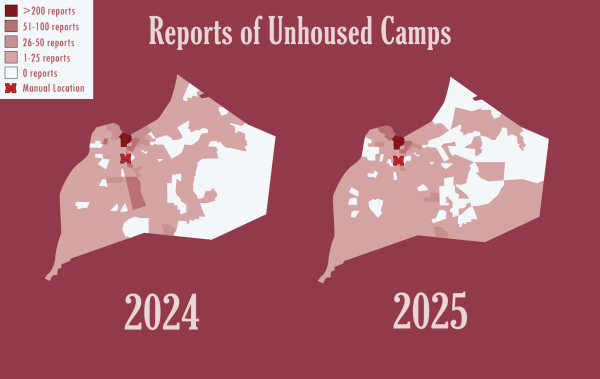
In recent years, the city of Louisville has relocated various unhoused people from the streets. In 2024, Kentucky passed House Bill 5, criminalizing street camping. Continuous efforts have made it difficult for unhoused individuals to find safe and secure housing, especially in harsh winter conditions like the ones we see today.
In 2022, an ordinance was passed that, according to the Louisville Coalition for the Homeless, “focus[es] on how to remove unhoused people from public property, enforced by penalties.” Additionally, the Coalition for the Homeless released a report that showed that homelessness had increased by 41% over the past three years.
In that same year, Arthur Street Hotel, less than a mile from Manual, opened its doors to unhoused people in the area.
Arthur Street Hotel is a growing organization that focuses on addressing the matter of homelessness in Louisville. They prioritize planning housing arrangements along with preparing people to assimilate back into the community.
“Our core competency is housing and housing preparation. And when people say, whatever their needs are, we try to meet them where they are.” Jeff Brian, a service member at the hotel said.
“In two and a half years, we’ve served a little over 500 people, of which about 320 of those have made their way into housing and another 55 to 60 are currently being served in the hotel,” Brian said.
For other needs, like helping individuals search for a job, Arthur Street Hotel refers people to other non-profit organizations that can service them. The organization emphasizes that no matter what service an individual is in need of, they will find a way to assist them. Some of those shelters include Wayside Christian Mission and St. Vincent de Paul.

Reverend Richard Anderson founded Wayside Christian Mission in 1957. Their mission is to “respond to the human need of the poor and homeless.” Starting with only 10 beds nearly 70 years ago, they are now able to house hundreds of unhoused people.
In 2009, they bought their second location and converted it into a homeless shelter. They currently have two locations, Jefferson Street Campus and Hotel Louisville. They are usually open 24 hours and provide approximately 2,000 meals per day.
In the event of harsh weather conditions, Operation White Flag goes into effect. Participating shelters will wave a white flag on the outside of their facilities announcing to all that the operation is ongoing. In these instances, Wayside Christian Mission as well as other shelters provide warming centers and other assistance to help those who are most vulnerable.
“During Operation White Flag, Wayside Christian Mission agreed with city requests to provide emergency transportation for people out in the cold to Wayside or other area shelters … This was a life saving activity which resulted in many people entering shelter during the coldest days,” Wayside Christian Mission released in a statement.
St. Vincent de Paul, founded in 1853, is a faith-based organization that serves not just the unhoused but also the impoverished and mentally ill. Their mission is to “house, feed and support those in need with compassion and dignity.” They provide shelter for 425 people every night, and their community kitchen serves 175 people daily.
In 1982, they were given the St. Paul church, and in 2011, the church underwent a multimillion dollar expansion adding multiple new buildings. Located on South Preston Street, only a few blocks from Manual, they offer food, permanent and temporary shelter and counseling.
The Arthur Street Hotel is an emergency shelter meaning they provide immediate temporary housing. They often assist people who have been turned away due to reasons like behavioral health issues or substance abuse. The hotel only services adults due to the temporary nature of their stays and because of the varying stages of recovery.
“We try to figure out how to disrupt root problems,” said Dr. Susan Buchino, executive director of Community Advocates for Resources and Empowerment (CARE) with Arthur Street Hotel.
Many of the unhoused citizens coming in don’t have the connections and opportunities needed to succeed, so Arthur Street Hotel provides those necessary connections and resources.
“We have a licensed marriage and family therapist on staff. She does the primary intakes for us because it starts to develop that rapport and relationship,” Buchino said.
It is not required for the unhoused individuals to take up the counseling. Additionally, they have different programs that connect them with former unhoused people who are in recovery along with other mental health practitioners.
Arthur Street Hotel typically takes in unhoused citizens who have been out of houses or shelters for four and a half years. To be able to get into a shelter like Arthur Street Hotel, one must meet certain qualifications and receive a voucher.
The local Public Housing Agency distributes Housing Choice Vouchers (HCV) to people in need. According to the U.S. Department of Housing and Urban Development, HCVs “[help] low-income families, elderly persons, veterans and disabled individuals afford housing in the private market.”
She explains that while the hotel is there to lift up individuals, ultimately it’s up to them to take the initiative to have a fresh start.
Given Manual’s location, homelessness is a common sight for students. Although no encounters have been reported by students, some unhoused people have wandered onto the school’s campus. Jon Palmer, Manual’s security monitor, has found people outside of Manual’s three buildings.
“I come across a lot of homeless people that use our campus as a place to reside through the night and sometimes the early mornings,” Palmer said.
When dealing with unhoused people early in the morning, Palmer is often met with kind interactions after asking individuals to leave the premises.
Erin Moss (Science) spends a couple days a week working with unhoused children through Volunteers of America (VOA). VOA has a location just under two miles from Manual. Moss primarily works with elementary school age kids on their schoolwork, specifically reading and math.
There are multiple programs within the VOA that assist with family’s complex living situations, but Moss focuses on bettering their skills in school.
“The VOA helps people get back on their feet. One of the families I work with was just able to move into an apartment, and the kids were telling me all about it,” Moss said.
Families will come into the VOA for their children’s tutoring sessions for any given amount of time. Some families consistently come in, but others come and go. Not only do they get help with school work, they also get to interact with someone in a safe environment.
“In this city, and even in the country, there has been an increase in homelessness due to raised costs, and wages are not keeping up with the cost of inflation. I do think that we have a problem in this country with a big separation between high wealth and low income people,” Moss said.
Nicole Finley (English), also works directly with unhoused people through JCPS’ Homeless Education Department. This program works alongside homeless shelters as an extension to the classroom.
The program assists students who are struggling to find stable living conditions, like living in cars, doubled up, or couch-surfing. Finley’s role in this is orchestrating all the volunteers that go into these shelters, whether it be St. Vincent de Paul, Wayside or VOA.
Once placed, they work to help with the struggles unhoused students experience, the most common being chronic absenteeism. This program aims to teach students missed curriculum, offer tutoring and be a constant for them.
Orchestrating this system is a big undertaking, meaning Finley is on call every evening. While it’s a lot of work, on top of a full time teaching position, Finley is seeing a change in the community for the better. Finley has noticed kids staying longer to receive services instead of being passed around from shelter to shelter. This program gives students the opportunity and support to be successful.
“You might have some who might just come and just need services for just three or four weeks, and then they’re gone … we just try and be that constant for them,” Finley said.
Many of Louisville’s volunteer and nonprofit organizations are taking measures to address the homelessness around Manual and in the city as a whole. The work done by these organizations has provided unhoused people with shelter and opportunities to improve their living situation. With the continued dedication to change the lives of the city’s unhoused, more of Louisville’s citizens will be able to secure safe housing.