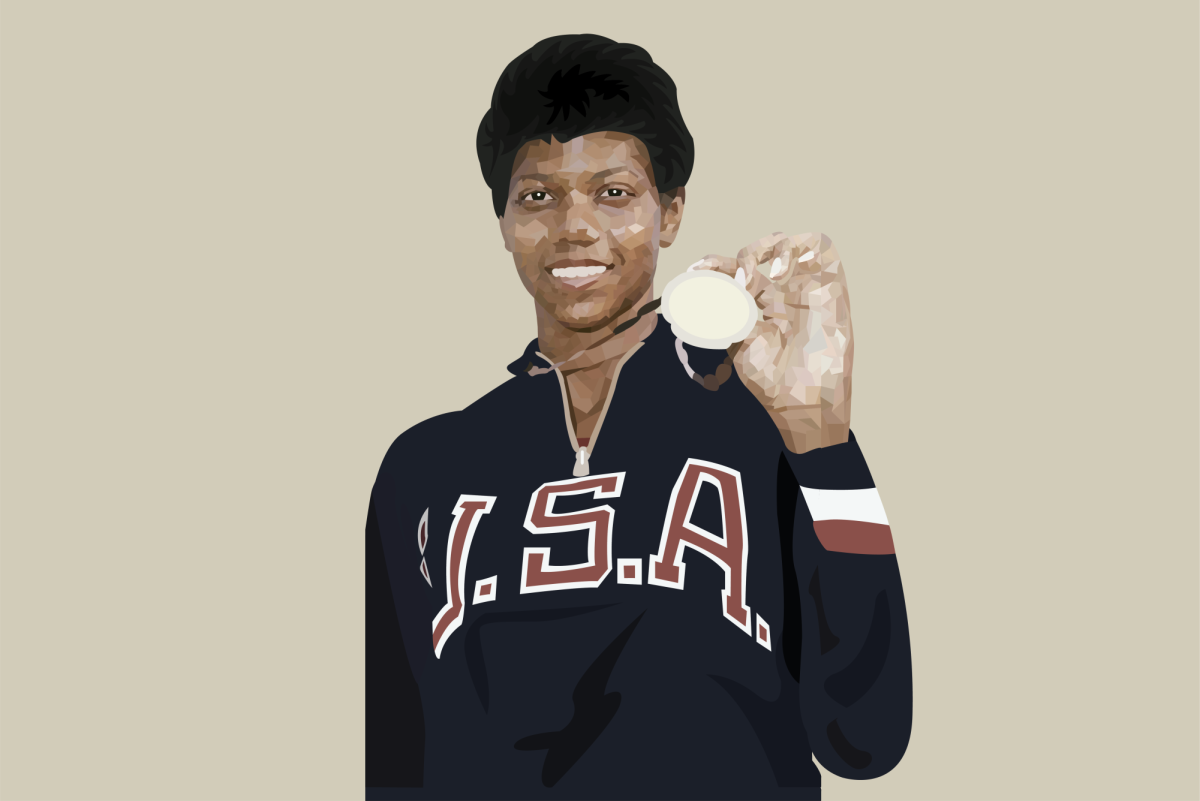
Wilma Rudolph conquered multiple childhood obstacles — including being told that she would never be able to walk again — to win three gold medals in the Rome 1960 Olympic Games. Rudolph is an inspiration to both sprint runners and the general public. She is a flawless example of perseverance and drive.
Rudolph was born on June 23, 1940, in St. Bethlehem, Tenn. At the age of four, she suffered from multiple ailments, including double pneumonia and scarlet fever. After this, she developed polio, resulting in her left leg becoming paralyzed. To help her move around, Rudolph used a fitted metal brace and a specially made shoe.
“I spent most of my time trying to figure out how to get [the braces] off,” Rudolph said.
Through the support and love from her family, as well as medical assistance, her leg slowly started to heal. Her mother aided this recovery by making weekly trips into Nashville, a round trip of 90 minutes, to visit the doctor. Rudolph was born during the time of Jim Crow laws and, therefore, had limited healthcare opportunities. Consequently, they faced the long travel times.
“My doctor told me I would never walk again,” Rudolph said in her autobiography. “My mother told me I would. I believed my mother.”
Turns out that her mother was correct. By the age of 11, Rudolph was capable of running. This was an incredible and rare feat at the time.
She began playing basketball at 11 and joined the team at the all-African American Burt High School. Here, her coach, C.C. Gray, gave her the nickname “Skeeter.” Rudolph set her first state record of 49 points in one game.
Ed Temple, the Tennessee State track and field coach, began working with Gray to set up a girls track team. His goal was to transition a forward player into a sprinter. Rudolph was perfect. She was naturally gifted at running.
“I don’t know why I run so fast,” Rudolph said. “I just run.”
Rudolph fell in love with the sport and began attending college practices while still in high school. This was not an easy task, and she was still held at the same standard as the college athletes. Temple was incredibly passionate but strict. He had a rule that every minute a runner was late to practice they had to run an extra lap. Once, Rudolph had overslept by 30 minutes, and she had to run 30 extra laps. The next morning, she was waiting at the track 30 minutes early.
Her incredible speed set her apart from teammates, which led her to a lot of success early in her career. At the age of 16, while she was still in high school, Rudolph qualified for the U.S. Olympic Team in the Melbourne 1956 Olympic Games. She competed in the 4×100 meter relay, and in her first Olympics, she brought home a bronze medal.
In 1958, Rudolph became pregnant with her first child, Yolanda, as a senior in high school. This hindered her abilities to continue basketball, but she still had goals left back on the track. This led to her return at the Rome 1960 Olympic Games.
Here she had an unbelievable performance, taking home three gold medals. She raced in the 100- and 200-meter races, as well as the 4×100 meter relay. She set a world record in the 100 meter sprint, and an Olympic record in the 200-meter preliminary heat. During that week, Rudolph was given the title of “Fastest Woman in the World.” She also became the first American woman to win three gold medals at a single Olympic Games. She was nicknamed “The Black Pearl” and “The Black Gazelle” by newspapers.
“She’s done more for her country than what the U.S. could have paid her for,” Temple said.
After her success at the Olympics, Rudolph continued her racing career for two more years before ultimately deciding to retire from competing. While she decided to step away from the sport, she still held her world records in each event.
Later on in life, she had three more children; Djuanna, Robert Jr. and Xurry. She worked as a track coach at DePauw University and served as a U.S. goodwill ambassador to French West Africa. Rudolph claimed that her greatest accomplishment was creating the Wilma Rudolph Foundation, which is a non-profit community-based amateur sports organization.
“I tell them that the most important aspect is to be yourself and have confidence in yourself,” Rudolph said. “I remind them that triumph can’t be had without struggle.”
She was voted into the Black Athletes Hall of Fame in 1973 and the National Track and Field Hall of Fame in 1974. NBC also created a movie about her life, titled “Wilma.”
Unfortunately, Rudolph died from brain and throat cancer on Nov. 12, 1994, at the age of 54.
“Her extraordinary calm and grace are what people remember most about her,” said Bill Mulliken, a 1960 Olympics teammate of Rudolph’s. “She was beautiful, she was nice, and she was the best.”
Rudolph was, and still is to this day, an inspiration for Olympians and non-Olympians alike. Her drive and dedication helped push past all the complications in her early life, resulting in her defying conventions and setting world records.