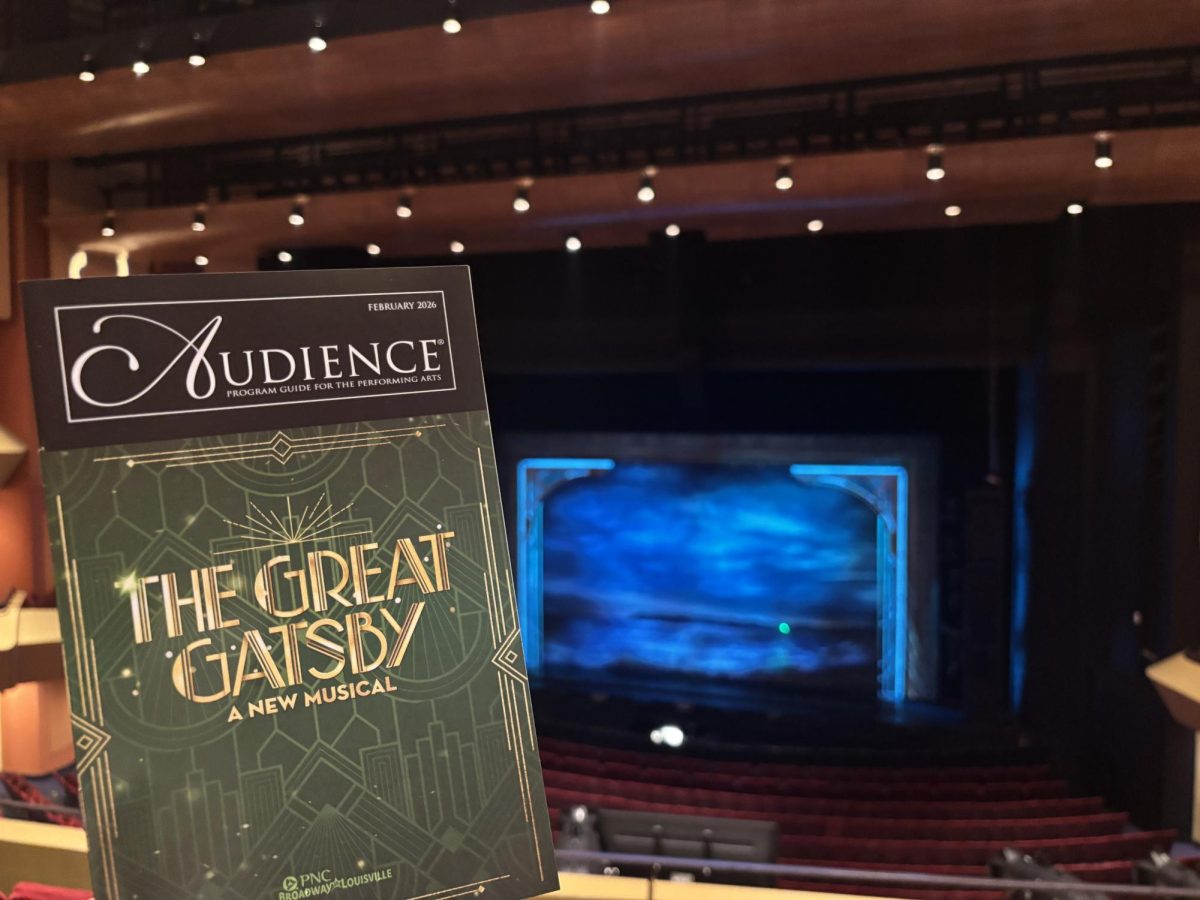
As the audience walks into Whitney Hall, they’re greeted by a stage backdrop depicting a tranquil bay and a lone green light shining from across the water. This green light is one of the most famous symbols in American literature, one from F. Scott Fitzgerald’s novel “The Great Gatsby.”
From Feb. 10-15, 2026, the Kentucky Performing Arts Center is hosting the broadway musical of the same name, a musical that wonderfully conveys the messages of the story by reminding us that money and happiness are not always one and the same.
The story opens with Nick Carraway (Joshua Grosso) moving to New York City after World War I. After reuniting with his bubbly cousin, Daisy Buchanan (Senzel Ahmady), and meeting her friend, Jordan Baker (Leanne Robinson), Carraway is swept away into the extravagant world of the New York elite of the Roaring ‘20s. He then meets his neighbor, Jay Gatsby (Jake David Smith), a mysterious, wealthy man known for throwing lavish parties.
Carraway soon finds himself as a central player in Gatsby’s efforts to win over Daisy Buchanan from her foul-tempered, cheating husband, Tom Buchanan (Will Branner). Also involved in the drama are humble mechanic George Wilson (Tally Sessions) and his restless wife, Myrtle Wilson (Lila Coogan). As the story unfolds, Carraway gets a glimpse of the upper class behind their sparkly facade and learns that the wealthy are not without problems of their own.
The cast of “The Great Gatsby” does a phenomenal job of bringing an old story to life. Every performer nailed their songs, from belting dramatic solos to capturing the fun spirit of the age in group numbers. Smith delivered a powerful performance of “For Her,” and Ahmady blew the audience away during her rendition of “Beautiful Little Fool.”
The cast also balanced the serious moments of the show with humor, leaving the audience laughing at Carraway and Gatsby’s shenanigans and Daisy Buchanan and Baker’s attempts to deal with the men in their lives.
The dazzling costumes and intricate choreography also serve to tell the story. Righteous Carraway starts the show with stiff movements and a plain brown suit, signifying his hesitance to join in on the partying lifestyle. He loosens up as he gets more comfortable with the rich, and starts to partake in the dances and costumes with the rest of the party goers. However, by the end of the show, he is back to being stiffly separated from the crowd in a plain suit as he becomes disgusted with the attitudes of the elite. These elements help visually convey Carraway’s disillusionment and add an extra layer of storytelling to a fast-paced show that fully immerses the audience into the atmosphere of the 1920s.
No review of “The Great Gatsby” would be complete without mentioning the green light. The color green is everywhere throughout the show. While Daisy Buchanan initially wears a white dress, she changes into a green dress once she learns Gatsby is in the city. Additionally, the set walls have a green tint to them. Right as the lights go out for intermission, two green lights flash at the audience as Gatsby and Daisy Buchanan kiss. When Gatsby’s hope for winning her back falters, the green light in the background grows dim before flaring again as he regains his certainty.
Though the story ends in tragedy, this show wonderfully demonstrates how everyone is reaching for something. Baker reaches for her independence, while Carraway seeks an escape from mundanity (and eventually a return to it). Daisy Buchanan and the Wilsons reach for security, though “security” means something different to each of them. Tom Buchanan chases pleasure, while Gatsby spends every waking moment striving for the love of his life.
In the final scene of the show, Gatsby stands with his back to the audience. His stark white suit contrasts with the green tinted backdrop of the bay, a green light shining across the water. He stands with his arm raised, forever reaching across the bay. This haunting image reflects some of his final lines in the show: “The light’s still green / And we’ve only begun.”
What the green light represents is up to the audience’s interpretation. However, it is certain that this production of “The Great Gatsby” does an astounding job of leaving the audience with the message that we’re all reaching out for something. No matter how hopeless it may seem, all of us are like Gatsby in some way; whether it’s love, money or some other desire, each of us has a green light of our own shining from across the bay.