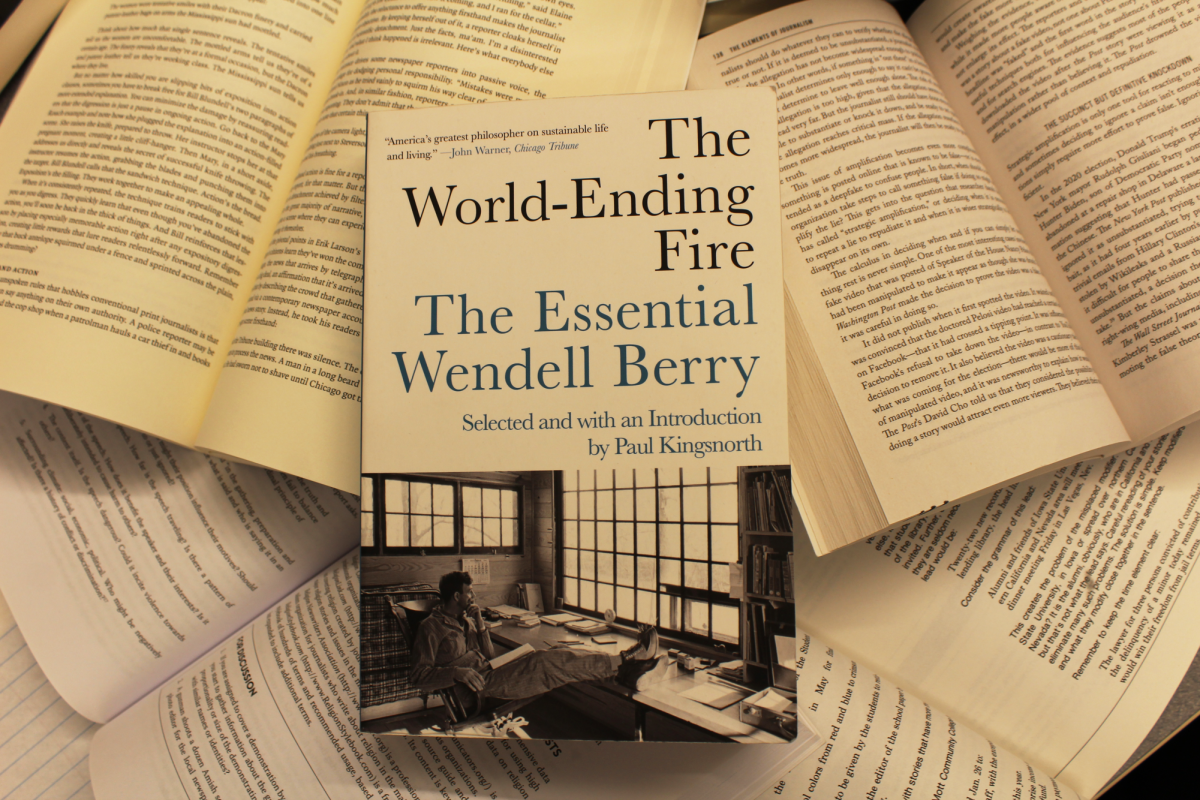
In the essay “In Distrust of Movements,” Wendell Berry names the Nameless Movement for Better Ways of Doing — “too long and uncute to go on a bumper sticker” — as a catchall for what he is trying to accomplish. This is a cheeky joke. It’s also pretty dumb in a lovable, extraordinarily clever way. Berry often wears those colors.
His biography is so all-important in his work that I actually have to write it out, which is usually an unconscionable waste of time for a review of some essays. He was born in Port Royal, Ky. (population: 34), 40 minutes northeast of Louisville. He got several prestigious fellowships out of college and a teaching job at New York University, which to writers in the 1960s was like a knighthood.
Not to Berry. He quit, got a job at the University of Kentucky, and bought a farm next to his homeland, where he still lives.
“I knew I had not escaped Kentucky, and never really wanted to,” he writes in “A Native Hill,” the first essay in “The World-Ending Fire.” Berry is one of those writers with an eye for every detail, so I feel comfortable zooming in on the word “escaped.” Its two meanings are Berry’s central conscience, the huge idea that all of his essays take slices from.
He’s definitely being ironic here. A whole line of people at his old work and around the city looked at New York City like the golden fountain that Spanish explorers died searching for. It was nourishing — it was nourishment itself. Read some novels from that time (Saul Bellow probably did it best) and you get the idea that the city just is life and that the lunacy of other places only identifies them as prime targets for the colonization of New York.
And here was Berry, calling it quits. The word “escaped” makes fun of the people who treat his home like a prison.
But Berry is never entirely sarcastic. He is a slant truth teller, a half-joker. He says at one point that “individualism goes around these days in uniform, handing out the party line on individualism.” They’re jokes that you can blink and miss, and that also have a real and pretty airtight opinion behind them.
Ditto with “escaped.” Berry realizes how imperfect his place is. In “Native Hill,” he talks about how hard it is to practice a culture that would not have existed without slave labor, along with heaps of oppression toward women and poor sharecroppers. Berry has every reason to flee all that, guilty and ashamed, but instead, he defends the agrarian lifestyle without getting too nostalgic, acting like a journalist rather than an advertiser.
He sort of succeeds. Though a careful or thorough reading will show the opposite, plenty of smart people read Berry and think that he wants everyone to become a farmer and never leave their town. They take all his jokes as snarky and begrudged, and ignore that reflective glare that all of them have.
Maybe this proves the anti-country bias that Berry interrogates. If he were a philosopher at Oxford or some college nestled in a metropolis, this misinformed dismissal would seem crazy. His zipcode makes him a flyover thinker, one who deserves reading only to figure out whether he is a messianic genius or a backwards hillbilly.
Obviously, he’s neither. Read Berry closely and you’ll find a simple enough instruction: be responsible. Don’t treat the land like you know it perfectly. Don’t detach and intellectualize your causes with a parade of slogans and organizations. Live intentionally, and learn a place while you live there.
Slow down, above all. Berry describes a bucket that has sat in the same place for years, full of soil and dead worms. It’s gross to behold. But it’s natural, and endlessly interesting. We can experience the beautiful world that Berry celebrates whether it’s in a sidewalk crack or the Grand Canyon. We only need the time and care to hold it up to our imagination.