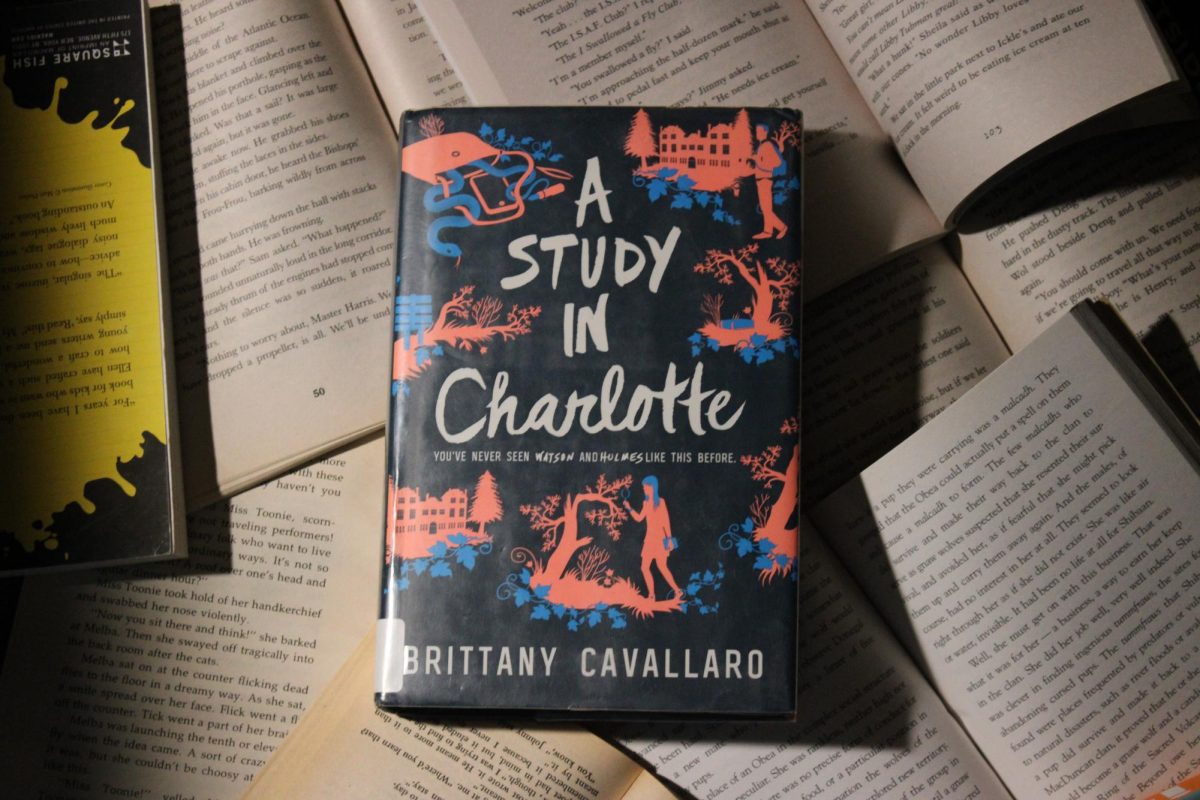
When I first pulled Brittany Cavallaro’s “A Study in Charlotte” off the shelf, I didn’t think I would like it. I judged a book less by its cover and more by its premise: a female, teenage Sherlock Holmes.
I’m a serious Sherlock fan and I’m constantly looking for YA novels with realistic teen heroines. However, I’m far too used to the trope where a traditionally male character is reinvisioned as a woman and we’re supposed to fall out of our seats with ecstasy due to the representation. I want to see an authentic, original female character that isn’t just a spin-off of her significantly more famous male counterpart.
To my surprise, Charlotte Holmes was exactly that.
The novel is set at Sherringford, the boarding school in Connecticut that Jamie Watson finds himself tossed into due to his estranged father’s wish to reconnect. Jamie finds the offer repugnant and his situation unfortunately dull until he runs into Charlotte Holmes, the great-great-great granddaughter of Sherlock, one of the very people his mother told him to avoid.
Despite her warning, Jamie pursues a friendship with Charlotte, which drops him straight into the case of Lee Dobson’s mysterious death, as the police’s main suspect. He works with Charlotte relentlessly to solve the case before the police, who are convinced that Charlotte and Jamie are involved.
Charlotte had a vendetta with Lee since freshman year, but Jamie doesn’t know why. All he can do is trust her, even when he’s been told she’s the last person he should trust. As they work together, Jamie begins to see past her mysterious nature. She’s not the emotionless oddity everyone thinks she is; in fact, she’s terrified.
This case started far outside of Sherringford’s campus, decades before Charlotte and Jamie were born. With the stakes heightening, and Charlotte’s total lack of inhibitions, each day could be their last.
But, Jamie won’t leave Charlotte alone with her investigations and addictions. He’s not sure exactly what makes him stay; maybe it’s curiosity, attraction or concern. Maybe it’s fate. In the end, it doesn’t really matter; Jamie’s life is now entangled in Charlotte’s mysterious world, and they have to find the killer before the killer finds them.
This novel stands out to me for so many reasons, the main one being the characterization. Many books about teenagers solving a crime require the characters to have an unrealistic level of maturity, to the point where they seem like adults the author tries to convince you are high schoolers.
Cavallaro’s characters are definitely high schoolers. She allows Charlotte to be scared, even terrified. She allows Charlotte to fail, time after time, and make mistakes that aren’t just a bump in the road. Each action has an impact.
Nowadays, so many heroines’ strengths are measured in their adherence to traditionally masculine traits. They are physically strong, incredibly smart and emotionally cold. They are often aggressive, blunt and dauntless. Charlotte exhibits all those characteristics at points throughout the story, but they aren’t her only attributes.
Her strength isn’t based around a masculine archetype. She laughs and loves, worries and cries. She is emotional in a way that has always been labeled as feminine, which now seems to be considered a synonym for weak. When she shuts down and pushes people away, she isn’t praised for it. She isn’t considered stronger because she’s going it alone.
Jamie is more emotionally mature than she is, a trait that isn’t commonly shown in male characters. He makes efforts to reach out to her, but he’s a teenager with his own struggles, and he can’t always provide all the support she needs.
People, especially teenagers, aren’t always able to be strong for their loved ones. They aren’t even always able to be present. Conversations can go poorly, words intended to comfort can fail. Yet people can still grow stronger individually and together, despite obstacles. Cavallaro presents this experience so authentically through Jamie and Charlotte, two adolescents who both desperately need a level of support they can’t always find in each other.
That’s a realistic dynamic.
Fictional teen relationships are often depicted as an end-all be-all, when in reality, such a relationship can develop into codependency. In “A Study in Charlotte,” Jamie doesn’t think of Charlotte as the only person he can count on, and vice versa. In this way, Cavallaro creates a strong, original bond between the characters.
In this way, Cavallaro tells the witty, fast-paced story of two realistic characters in an unusual case of murder, deceit and tragedy.