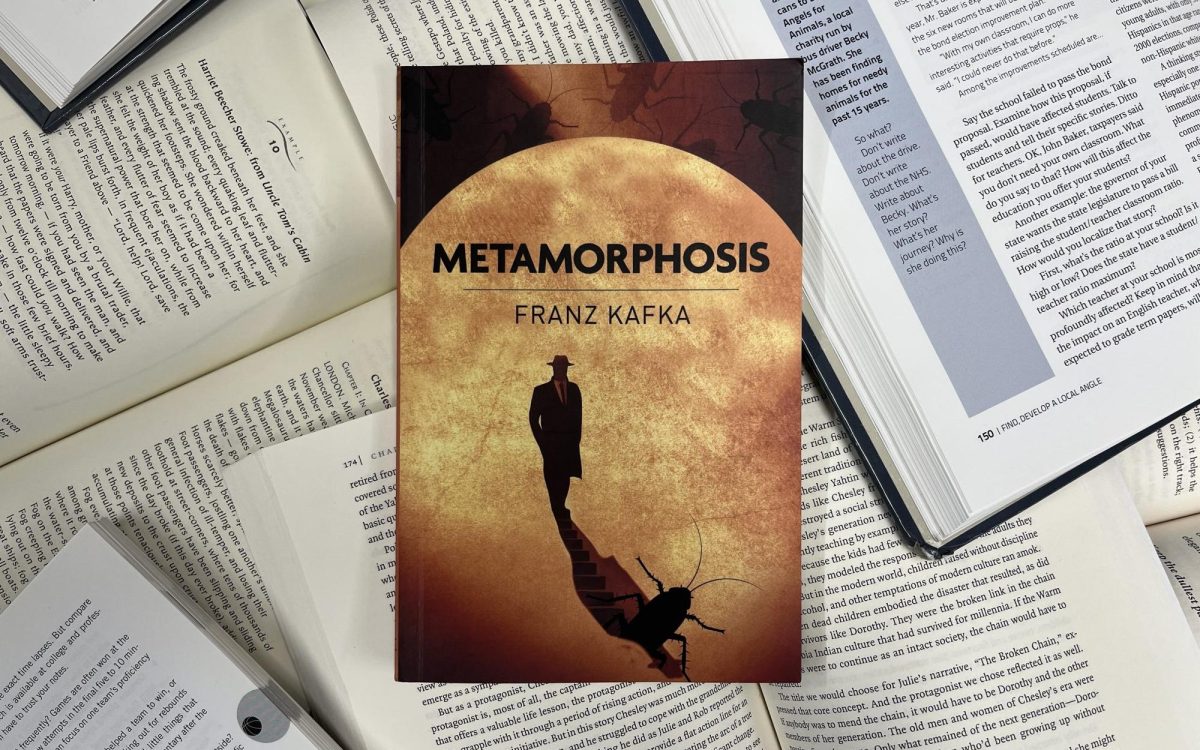
Franz Kafka’s “The Metamorphosis” turned what I thought would be an impulse read to fill my free time into an immediate favorite and a novella with such intense relevance and imagery that I haven’t been able to erase from my mind since. The characters, so deeply portrayed with a sense of human empathy that breaks the barriers of time, have stuck with me, and their losses and hardships I continue to grieve as my own.
The story follows the young Gregor Samsa, a traveling salesman whose family depends on his income. One unfortunate morning, he wakes up to discover that he has transformed into a large insect.
Samsa’s initial panic surrounds his ability to attend work rather than the fact that he is no longer a human. Eventually, his family discovers his new deplorable state and attempts to care for Samsa. However, the strain becomes too much for the family and they slowly start to resent Samsa as they all take on more responsibilities to support themselves.
The story embodies a unifying factor among the human experience. Essentially it’s a ridiculous plotline. The idea that a human would one day wake up as a giant beetle and furthermore the primary concern on his mind is missing work is laughable — and Kafka intends this.
Kafka’s tale is a distressing one, yet the blunt tone with which he writes lines the pages with humor, at times coaxing dry laughter out of the reader. This bluntness with which Kafka paints the completely fictional story is a testament to how universal the metaphor of isolation and dehumanization described in the novella is.
A theme of power also echoes through the novel, with Samsa’s state resulting in numerous power struggles between him and his sister, his father and his employers. The complex family dynamics and work obligations explored through Kafka’s metaphor ring true even today, long after its first publication in 1915.
Perhaps the reason why Kafka’s “The Metamorphosis” is so deeply moving and realistic is because Kafka largely drew inspiration from his own family dynamic. Hermann Kafka, Franz Kafka’s father, was an inspiration for much of Franz Kafka’s writing in which he portrayed the power struggles between weak and vulnerable anti-heroes and greater authority.
Hermann Kafka was disappointed in Franz Kafka’s sensitivity and liking for literature, and he made this disappointment clear through his abuse of Franz Kafka. This relationship is echoed in Samsa and his father’s relationships, as Samsa’s father attempts twice to kill him.
Upon the release of Franz Kafka’s novella, many looked to analyze the work through a Freudian lens. Kafka renounced this.
“To Kafka the whole point of art – or at least his art – was that it stood outside and went beyond simple explanation, into realms of ethical enquiry that made Freud’s ‘scientific’ solution redundant,” William Aaltonen writes in his introduction of the novella.
These “realms of ethical enquiry” are what allows the novella, like much of Kafka’s work, to resonate with readers today. His metaphor is evergreen, applicable across decades. The work exhibits genius with a realist, blunt tone, and it more than lives up to its well earned reputation as a classic.