Writing a novel about rock singers sounds almost as hard as their drugs are. “Men pluck out chords in a sound-dead studio” isn’t fun, nor is “men trash hotel rooms and cheat on their wives.” A writer who wants to make something unique might run away from rock entirely — write something, dry, colorless, designed to prove that a hard life doesn’t pay, ending with a washed-up crew surrounded by Gibson Flying V guitars and empty cans of hairspray.
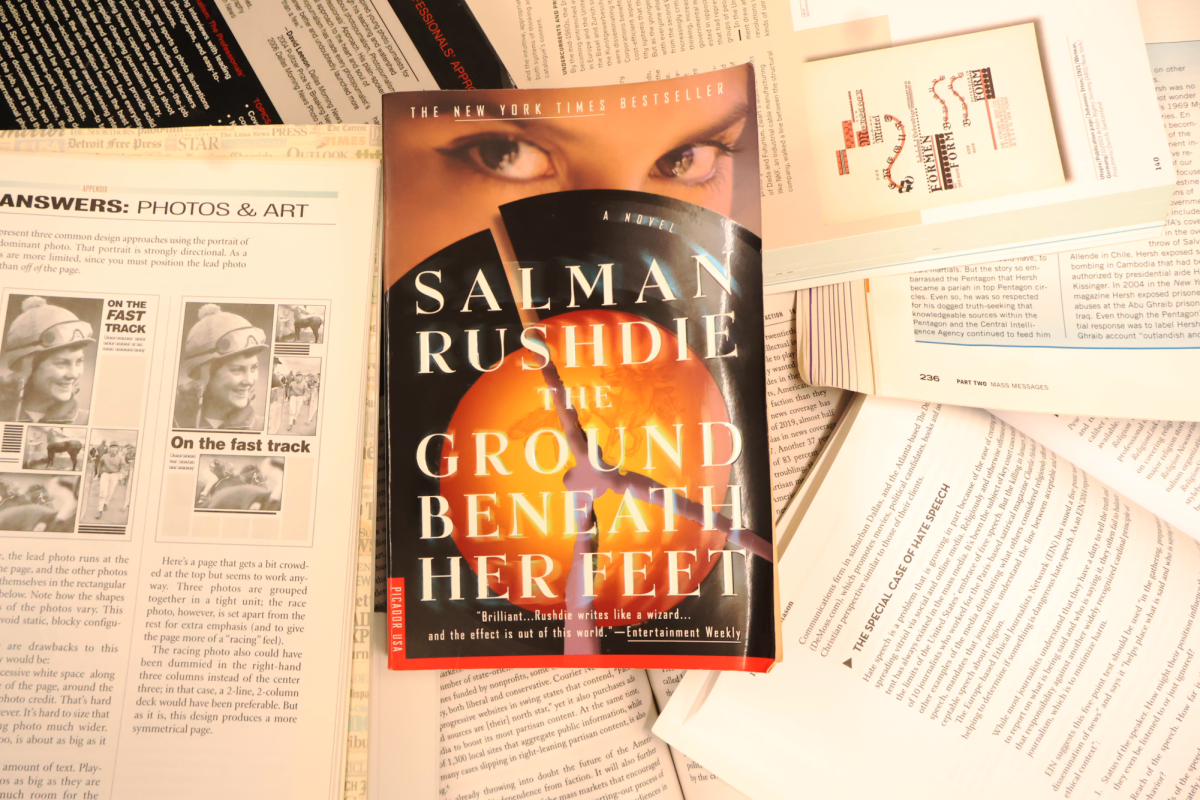
But Salman Rushdie doesn’t write morality tales. He writes big, space-taking epics, ones where reality is like a hardened clay that falls when tapped too hard. “The Ground Beneath Her Feet” (1999) must be his most criminally undersold book: flying, wailing, burning hot. Here is a novel where every line feels like it’s set to the music that the characters make.
In true Rushdie fashion, there are half a dozen plots, but the main one retells Orpheus and Eurydice with Ormus and Vina, two singers from India, though that understates it like crazy — they are singers in the way that fire hydrants are faucets.
We all know the story: Orpheus, the best singer and lyre player that anyone has ever heard, meets Eurydice. Everyone loves him. They love each other more than any pair of normal people love each other. She dies. Like a typical successful singer-songwriter, he puts his hurt feelings over the literal fact of mortality. He goes into the Underworld and sings Hades a song that he loves so much that he will let Eurydice follow Orpheus out, stipulating that Orpheus cannot look behind him to see if she’s there.
He makes it to the very end, when he checks on instinct, and sees his lover fading behind him.
Whether Orpheus was a death-defying hero or a reality-fleeing coward is a question that Rushdie, in several random asides, visits throughout. Maybe, he says at one point, Orpheus is actually a coward because he refused to die and join Eurydice in the Underworld. He wouldn’t die for love.
Prudent or not, that route gets plenty of airtime in “The Ground Beneath Her Feet,” although it usually looks more like soul death than like body death. Rushdie has people who stay hooked onto reality and ones who stay locked out of it, and none of them are happy. The play between observation and fantasy — that is what joy is all about.
Rushdie’s stories are weird, almost circus-like. No real person is visited and kissed repeatedly (among other things that I’ll omit; this is a high school publication) by a beautiful and mean teleporting woman when they’re in a coma. No real person gets out of a coma when a girl whom they love but haven’t seen in years shows up and says some kind words. But beauty drags everyone out of a stupor here and there, in one way or another. And terrible things visit us while we are in one. Rushdie never loses the second half of his genre, “magical realism.”
If there is anything about Rushdie that I can call common knowledge, it’s that his novel “The Satanic Verses” (1988) nearly got him killed. The Ayatollah of Iran, Ruhollah Khomeini, called it an affront to Islam and called on every Muslim to kill him for the faith. He hid for years afterward.
Given the hate that surrounds us, it’s important to say that many Muslims deplored this order, and that most of them did not heed it. It turns out, though, that one or two is all it takes — at a speech in 2022, a man jumped on stage and stabbed Rushdie 15 times.
So here Rushdie was, a few years after that order went out, writing a novel that was more radical and experimental and irreverent and plain old fun than the one that would later put out his eye. His work danced in a way that the world had forbidden him from. No wonder he wrote about what he did — that’s more rock ’n’ roll than any album can claim to be.
So, so many things matter to us more than truth does.
Rai, Vina’s first love and her fling during bad years with Ormus, narrates the book. Rushdie spends 50 pages on Rai’s investigation of an Indian mogul’s goat fraud (don’t ask) that ends up giving him a rulebreaker’s reputation and catapulting him to political success, despite being a depraved lunatic.
Families die. Family members become murderers. Worldwide commercial empires hold entire industries at their mercy. Talented bodies fall apart. A love story is a love story, but Rushdie has never written a happy book, as far as I have read. (I’m also obligated to say that he has never written a PG-13 one — be warned.) So let “The Ground Beneath Her Feet” in, and dance with it, as if you were there with its stars themselves.