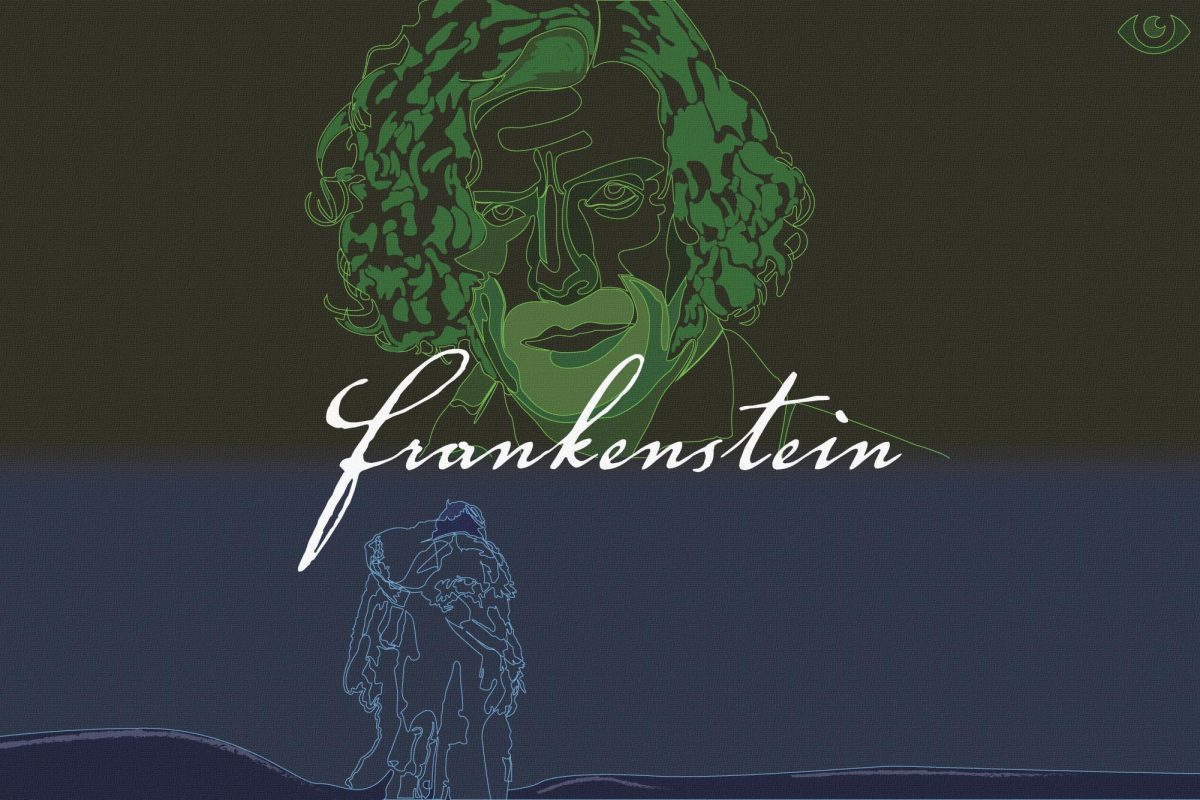
When most people hear the word “Frankenstein” they automatically think of the big green monster with bolts keeping his neck together or a Halloween costume. However, in the original story by Mary Shelley, Frankenstein is actually Victor Frankenstein, the scientist who created his “creature.” The novel is a gothic science fiction where Shelley writes about a Swiss scientist who searches for the secret of life and, when he finds it, creates his creature from old body parts.
The film “Frankenstein,” directed by Guillermo del Toro, came out on Oct. 17, 2025. Del Toro made it clear that the film wouldn’t be the most accurate adaptation and many fans of Shelley’s novel were worried he wouldn’t stay true to the story. While the movie did change parts of the plot and leave scenes out, it still managed to capture the story’s emotional depth and its core ideas.
After watching the film, I can say that it was, without question, one of the most emotionally rich films I’ve seen. The film perfectly balanced out the changing perspective between the creature and its creator and the consequences of trying to play God.
The acting was also remarkable. The creature, played by Jacob Elordi, didn’t speak much for a majority of the film other than the words “Victor” and “Elizabeth.” A lot of the creature’s emotional expression had to be done through the eyes and through body movement, and Elordi did an outstanding job.
Oscar Issac, who played Victor Frankenstein, portrayed Victor as an emotionally troubled man who strives to be better than his father but slowly ends up becoming his father. Issac successfully conveyed the ambitious and ruthless nature of Victor when it came to his creation.
While the acting was amazing and the cinematography was wonderfully crafted, the true highlight of the film was the story itself. What stood out most was how del Torohandled the differing perspectives. Instead of doing a third-person-omniscient point of view or focusing specifically on Victor, del Toro successfully split the movie into two parts: Part I [Victor’s Tale] and Part II [The Creature’s Tale]. The dual perspectives allowed both voices to exist fully within the story, making it feel more about growth within one’s identity and less like a creature vs. creator narrative.
The creature’s narrative was my favorite part of the movie, especially when the film focuses on the creature learning how to live and demonstrating the nature vs. nurture environment. The creature is born pure, but through hardship he learns to be cruel, having been denied the one thing he wants most: death. In the creature’s point of view, the film explores how he observes and tries to understand the world around him, adding a level of quiet, raw emotion within Elordi’s character.
One of my personal favorite parts of Part II was watching the creature develop a bond with a blind grandfather who lived in a cottage alone after his family left him to go hunt for the wolves terracing their home. It is one of the only moments where the creature isn’t judged by his appearance, and that detail showed what it means to be seen for who you are rather than what you look like.
Victor’s storyline is just as compelling, especially when comparing his childhood trauma to how he acted when he was older. Victor’s father, Baron Leopold Frankenstein, was a renowned doctor and constantly pushed him to study the medical field and Victor slowly began to resent his father, promising to be even better than him one day.
His background demonstrated that Victor’s ambition wasn’t just about science, it was about proving himself, proving that he truly was the best there was. However, that constant pressure to be better slowly turned destructive and del Toro showed how easily determination can become obsession. This idea of “playing God” is shown through Victor’s choices and the repercussions that later come about throughout the film.
Lady Elizabeth Harlander, played by Mia Goth, is Victor’s younger brother’s fiancee, and she adds a different perspective, one that challenges Victor’s understanding of his creation. While she’s first introduced through her connection to Victor as his soon-to-be sister in-law, her role becomes more significant as she begins to observe both Victor and the creature more closely. As the film progresses, Victor begins to develop feelings for her and even asks her to marry him. Instead, Elizabeth refuses, adding tension to their relationship.
What stood out the most about Elizabeth was how she interpreted Victor’s creation. Instead of viewing the creature as a monster or a feat, Elizabeth saw him as human and a victim of Victor’s unjustness, viewing Victor as the true monster instead. This adds another layer to how the film questions who the true monster is.
Overall, del Toro’s “Frankenstein” is less about horror and more about humanity, identity and the consequences of ambition. By balancing Victor and the creature’s perspectives, the film avoids turning into a story that’s simply just creator versus creation and instead shows how both are shaped through their experiences and own choices. It is not the idea of a monster that becomes the central theme of the film, but the realization that the line between humanity and monstrosity is thinner than it seems.